

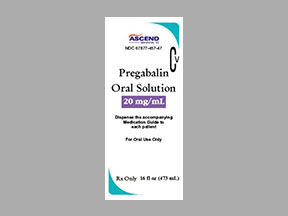
Pregabalin

Lyrica Coupons & Savings Card – Discount Prices from $6.11

Brand for: Pregabalin

Pregabalin, commonly known as Lyrica, is a medication primarily used to manage pain stemming from nerve damage associated with conditions like diabetes (diabetic peripheral neuropathy), shingles (postherpetic neuralgia), and spinal cord injury. It is also effective in alleviating pain in individuals with fibromyalgia. Besides its pain-relieving properties, Pregabalin is used as an adjunctive treatment to manage partial-onset seizures in both adults and children. This medication functions as an anticonvulsant. Although its precise mechanism of action is not fully understood, it is believed to modulate certain brain chemicals, thereby reducing pain and preventing seizures. Pregabalin is typically administered orally, available in capsule and oral solution forms, and is usually taken two to three times daily. Common side effects of Pregabalin may include dizziness and drowsiness. As with any medication, it is crucial to consult with healthcare professionals like doctors, nurses, or pharmacists before starting Pregabalin to ensure it is safe and appropriate for your specific health needs.
Our Lyrica coupons are free to use. You can print the coupon, email it to yourself, or receive the Lyrica coupon via text message. To get your free discount, show the pharmacist your Lyrica savings card which has the discounted coupon price. Use our filters below to edit the prescription box to match your needs. The Lyrica prices will update based on your prescription needs. Above our Lyrica coupons, you can change the location to see pharmacy prices in other areas. Our prescription discount card will update online with the specific pharmacy costs associated with your edits. Be sure to text, email, or print the Lyrica savings card code that you need after editing the prescription box and location field. Show the discount card to your pharmacist before paying.

My prescription

Edit

100MG, Pregabalin (60 Capsules)

Select pharmacy

CVS logo

CVS

$20.77

COUPON PRICE
Walmart logo

Walmart

$6.11

COUPON PRICE
Walgreens logo

Walgreens

$12.68

COUPON PRICE
Albertsons logo

Albertsons

$18.64

COUPON PRICE

Lyrica savings card

Show this card to your pharmacist
walmart logo

Walmart

$6.11

BIN

ID

PCN

GRP

019876

LHE440CE32

CHIPPO

LHX

Powered by

This coupon is not insurance
Pregabalin, commonly known as Lyrica, is a medication primarily used to manage pain stemming from nerve damage associated with conditions like diabetes (diabetic peripheral neuropathy), shingles (postherpetic neuralgia), and spinal cord injury. It is also effective in alleviating pain in individuals with fibromyalgia. Besides its pain-relieving properties, Pregabalin is used as an adjunctive treatment to manage partial-onset seizures in both adults and children. This medication functions as an anticonvulsant. Although its precise mechanism of action is not fully understood, it is believed to modulate certain brain chemicals, thereby reducing pain and preventing seizures. Pregabalin is typically administered orally, available in capsule and oral solution forms, and is usually taken two to three times daily. Common side effects of Pregabalin may include dizziness and drowsiness. As with any medication, it is crucial to consult with healthcare professionals like doctors, nurses, or pharmacists before starting Pregabalin to ensure it is safe and appropriate for your specific health needs.
Our Lyrica coupons are free to use. You can print the coupon, email it to yourself, or receive the Lyrica coupon via text message. To get your free discount, show the pharmacist your Lyrica savings card which has the discounted coupon price. Use our filters below to edit the prescription box to match your needs. The Lyrica prices will update based on your prescription needs. Above our Lyrica coupons, you can change the location to see pharmacy prices in other areas. Our prescription discount card will update online with the specific pharmacy costs associated with your edits. Be sure to text, email, or print the Lyrica savings card code that you need after editing the prescription box and location field. Show the discount card to your pharmacist before paying.

Related anti-epileptics prescriptions

coupons from$44.72Save 97%
coupons from$2.82Save 98%
coupons from$19.44Save 47%
coupons from$427.95Save 71%
coupons from$106.00Save -37%
coupons from$13.46Save 67%
coupons from$18.08Save 70%
coupons from$68.02Save 85%

More prescriptions for postherpetic neuralgia

coupons from$37.62Save 18%
coupons from$36.65Save 92%
coupons from$552.66Save 19%
coupons from$50.93Save 5%
coupons from$37.62Save 18%
coupons from$99.31Save 90%

Related anti-epileptics prescriptions

Spritam Save 97%coupons from $44.72
Keppra Save 98%coupons from $2.82
Oxcarbazepine Save 47%coupons from $19.44
Zonisade Save 71%coupons from $427.95
Carbatrol Save -37%coupons from $106.00
Roweepra Save 67%coupons from $13.46
Dilantin Save 70%coupons from $18.08
Eprontia Save 85%coupons from $68.02

More prescriptions for postherpetic neuralgia

Aspercreme Lidocaine Save 18%coupons from $37.62
Lyrica Cr Save 92%coupons from $36.65
Pregabalin ER Save 92%coupons from $36.65
Horizant Save 19%coupons from $552.66
Lidocaine Save 5%coupons from $50.93
Tridacaine Xl Save 5%coupons from $50.93
Zynalox Save 18%coupons from $37.62
Gralise Save 90%coupons from $99.31

Price history for Lyrica (brand) & Pregabalin (generic)

60 Capsules, 100MG

Average retail price for Lyrica

Average retail price for Pregabalin

Average SaveHealth price for Pregabalin

Our price history data is based on aggregated prescription data collected from participating pharmacies in America. Our prescription data updates daily to reflect the latest price changes. If you notice a missing data point, it means there wasn't sufficient data available to generate a monetary value for that date.

Over the last 12 months, the average discount price of Lyrica is $41.96 using the SaveHealth savings card. That's an average savings of 94.67% on Lyrica with our discount card.

*Retail prices are based on pharmacy claims data, and may not be accurate when we don't have enough claims.

Lyrica (Pregabalin) dosage forms

Use our Lyrica (Pregabalin) 25MG coupon with prices from $4.32 for 30 Capsules. You can also use our Lyrica (Pregabalin) 25MG coupon with prices from $6.14 for 60 Capsules. We have a Lyrica (Pregabalin) 25MG coupon with prices from $14.46 for 90 Capsules. You can use our Lyrica (Pregabalin) 25MG coupon with prices from $16.28 for 120 Capsules.
DosageQuantityPrice fromPer unit
25MG30 Capsules$4.32$0.14
25MG60 Capsules$6.14$0.10
25MG90 Capsules$14.46$0.16
25MG120 Capsules$16.28$0.14
25MG180 Capsules$23.20$0.13
50MG30 Capsules$4.35$0.14
50MG60 Capsules$6.20$0.10
50MG90 Capsules$14.55$0.16
50MG120 Capsules$16.40$0.14
50MG180 Capsules$23.73$0.13
75MG30 Capsules$4.26$0.14
75MG60 Capsules$6.01$0.10
75MG90 Capsules$14.27$0.16
75MG120 Capsules$16.02$0.13
75MG180 Capsules$24.47$0.14
100MG60 Capsules$6.11$0.10
100MG90 Capsules$7.92$0.09
100MG120 Capsules$9.73$0.08
100MG180 Capsules$19.84$0.11
100MG270 Capsules$31.39$0.12
150MG60 Capsules$6.74$0.11
150MG90 Capsules$8.87$0.10
150MG120 Capsules$10.99$0.09
150MG180 Capsules$21.73$0.12
150MG270 Capsules$29.70$0.11
200MG30 Capsules$4.83$0.16
200MG60 Capsules$7.16$0.12
200MG90 Capsules$9.49$0.10
200MG180 Capsules$22.98$0.13
200MG270 Capsules$31.20$0.12
225MG30 Capsules$5.13$0.17
225MG60 Capsules$7.76$0.13
225MG90 Capsules$16.89$0.19
225MG180 Capsules$26.24$0.15
225MG270 Capsules$31.85$0.12
300MG30 Capsules$5.22$0.17
300MG60 Capsules$7.93$0.13
300MG90 Capsules$10.65$0.12
300MG120 Capsules$13.36$0.11
300MG180 Capsules$25.29$0.14
Show more dosage forms >
Lyrica FAQs
Is pregabalin a strong painkiller?

Pregabalin is not classified as a traditional painkiller like opioids or NSAIDs. It is an anticonvulsant medication that is often used to treat nerve pain associated with conditions such as diabetic neuropathy, postherpetic neuralgia, and fibromyalgia. While it can be effective for certain types of pain, it is not considered a strong painkiller in the conventional sense.

Doctors may be cautious about prescribing pregabalin due to several reasons. Pregabalin has the potential for misuse and dependency, which can be a concern, especially in patients with a history of substance abuse. Additionally, it can cause side effects such as dizziness, drowsiness, and weight gain, which may not be suitable for all patients. There are also considerations regarding its interactions with other medications and the need to monitor for any adverse effects. Therefore, doctors weigh these factors carefully before prescribing pregabalin to ensure it is appropriate for the patient's specific condition and health profile.

The choice between gabapentin and pregabalin depends on the specific condition being treated, the patient's medical history, and how they respond to each medication. Both medications are used to treat similar conditions, such as neuropathic pain and certain types of seizures, but they have different dosing schedules and side effect profiles. Pregabalin is often considered to have a more predictable pharmacokinetic profile and may work faster, but it is also typically more expensive. A healthcare provider should be consulted to determine which medication is more appropriate for an individual's specific needs.

Pregabalin is often prescribed for managing neuropathic pain, which is pain caused by nerve damage. It is also used for conditions such as fibromyalgia and as an adjunctive therapy for partial seizures. While it can be effective for certain types of pain, it may not be the first choice for all types of severe pain, such as acute pain from an injury or surgery. A healthcare provider can determine if pregabalin is appropriate based on the specific type and cause of the pain.

Pregabalin primarily affects the neurotransmitter gamma-aminobutyric acid (GABA) by binding to the alpha-2-delta subunit of voltage-gated calcium channels in the central nervous system. This action modulates the release of excitatory neurotransmitters, thereby reducing neuronal excitability.